Decide · Staging
Pilot rollout plan for company-wide call audio
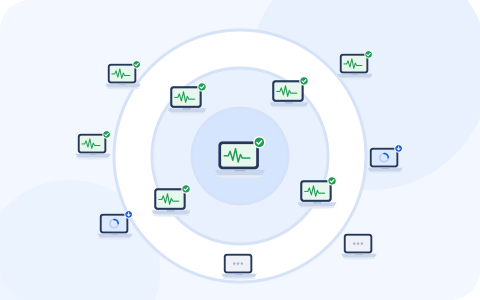
“It's just audio software” is the sentence that precedes an unstaged rollout, and it is wrong in a specific way: an audio layer sits in the path of every real-time call in the company, so the blast radius of a bad interaction is every meeting happening that hour. This is a small deployment that deserves a real ring structure, and the structure takes about a day to set up.
Before ring 0: capture a baseline you can't recreate later
This is the step that gets skipped and the step that decides whether you can defend the spend at renewal. You cannot measure an improvement against a baseline you never took, and you cannot go back and take it retroactively.
- Create the helpdesk category. Add “call audio” as a ticket category before anything deploys, and brief the service desk to use it — including for the vague ones, which are most of them. You are not going to see a decline in a category that didn't exist. (Why this category is chronically invisible: the ticket nobody owns.)
- Ask one blunt question. “In the last month, how often did background noise disrupt a call you were on?” with four options from Never to Most calls. Send it to the populations you intend to pilot on. It is unscientific, it takes ninety seconds, and it is the chart your CFO will remember at renewal.
- Configure the free levers and let them settle. Turn on the Teams policy levers and the Zoom suppression key first, and give them a week. Otherwise your pilot measures “suppression vs. nothing” when the decision you're actually making is “paid layer vs. properly configured platform.” Those are very different questions and only one of them is yours to answer.
The whole pilot, on one line
- Before ring 0BaselineTicket category, the pulse question, free levers left to settle a week
- Ring 0 · one weekIT + five to ten volunteersTests mechanics, not outcomes
- Ring 1 · two weeks minimumThe noisiest teamTests whether the outcome is real
- Ring 2 · by departmentEveryone in scopeExecution, not testing
- Day ninetyRead the gapAdoption under roughly 80% points at groups or comms
Ring 0 — IT and the volunteers
Who: your own team, plus five to ten people who live on calls and enjoy being asked. How long: one week. What you're testing: mechanics, not outcomes.
Ring 0 exists to find the things that make a package fail rather than the things that make a tool good. Deliberately include your oldest supported laptop model, at least two Macs, one machine that runs a softphone, and anyone in the company with an unusual audio setup — the person with the mixer, the person with three monitors and a dock that has opinions.
Ring 0 exit criteria
- The package installs silently in deployment context on both platforms, with no user prompts other than the macOS microphone consent (which nobody can remove).
- The detection rule reports accurately — no reinstall loop, no false failures.
- Virtual audio devices appear and survive a reboot and a dock disconnect.
- Sign-in routes to your identity provider without anyone typing a workspace name.
- The uninstall command has been run successfully on at least one machine. Yes, before ring 1.
- CPU impact on the oldest laptop is something you have actually looked at, on your hardware. We publish no benchmark numbers for anyone's fleet but their own.
Ring 1 — the noisiest team you have
Who: one real team with a genuine audio problem — support, inside sales, recruiting. How long: two weeks minimum, because week one is novelty. What you're testing: whether the outcome is real.
Pick the team by evidence, not volunteering. The team that complains most is usually the right choice; the team that volunteers is sometimes just the team that likes new software. Tell them plainly what you're doing and that you'll be asking at the end — a pilot people know they're in produces better data than one they don't.
| Signal | Where it comes from | What good looks like |
|---|---|---|
| Adoption | Vendor console usage data | Most assigned seats show real usage by week two. A large idle fraction means comms failed, not that the tool failed. |
| The pulse question | Re-ask the same four-option question | A visible shift out of the top two buckets. Small sample, directional, honest about being both. |
| Ticket volume | The category you created | Fewer, or at least differently-shaped, tickets. Two weeks is short — treat this as a trend indicator, not proof. |
| Unprompted comments | The team's own channel | Genuinely the most persuasive artifact you will collect. Screenshot them for the change board. |
| New problems | You, asking directly | Nothing that breaks a call. Softphone interaction issues, if they exist at all, surface here. |
Ring 2 — everyone in scope
Who: the seat tiers you scoped on the costs page — which is deliberately not everybody. How long: department by department, at whatever cadence your change process expects. What you're testing: nothing. Ring 2 is execution, and if you are still testing at ring 2, ring 1 ended too early.
Keep the exclusion group alive and keep watching the gap between assigned and installed. At ninety days, adoption under roughly 80% is a signal about your assignment groups or your comms, not about the software.
The comms, in three short messages
T-3 days, to the ring
What is happening, when, why, and the one thing they must do. “On Thursday your machine will install a background audio filter that removes keyboard noise, dogs and traffic from your microphone on every app. Mac users: macOS will ask once whether it can use your microphone — click Allow.”
Day of, one line
“It's installed. Nothing to configure — join your next call normally. If something sounds wrong, reply here and we'll look at it today.” The offer of a fast human response is what keeps problems in your inbox rather than in a corridor conversation.
Day 14, the ask
The same four-option pulse question, plus one open box. Do not editorialise about how well it's going in the message that asks how well it's going.
One standing note for security-conscious users, because it will be asked in every ring: the noise processing runs on-device rather than in a vendor cloud. Point them at the vendor's own security documentation rather than paraphrasing it yourself — a link you didn't write is worth more in that conversation than a sentence you did.
The rollback nobody writes down
Write it before ring 1, in four lines, in the change ticket:
- Trigger: what specifically causes a retreat — a call-breaking defect, not a complaint.
- Action: the tested uninstall command, pushed to the affected ring; assignment removed; platform levers left in place, since they were never the problem.
- Owner: a named person who can pull the trigger without a meeting.
- Communication: one line to the ring saying it's been removed and why.
Because you deployed by package and policy, you can retreat by package and policy — which is an argument for doing it properly that carries weight with change boards in a way that “better audio” never does. Ad-hoc rollouts don't get rollbacks; they get a spreadsheet of machines and a bad Friday.
Mistakes we'd flag in a pilot review
- No baseline. Covered above, and still the most common. It is unrecoverable after the fact.
- Piloting against an unconfigured platform. You will get a fantastic result and it will not answer your actual question.
- A one-week ring 1. Week one measures novelty. Week two measures the tool.
- Only happy machines in ring 0. The modern laptops all work. Put the 2019 one in.
- Letting the trial expire mid-pilot. Seven days is ring 0, not ring 1. Plan the conversion date before you start, or your evidence-gathering stops halfway through.
Ring 0 fits inside the trial
Krisp's 7-day trial needs no card and includes the Admin Portal (verified 20 September 2026), which is exactly the shape of ring 0: package it, push it to your own team and a few volunteers, and find the mechanical failures before any money is involved. Ring 1 is where you'll need real seats — and by then you'll know whether you want them.
Referral link, declared: when an organization licenses Krisp after clicking this button, Krisp pays RolloutDesk a fee, and the quote you receive is the one you would get going direct. “Configure the free levers first and pilot against them” is advice that costs us money, and it stays.
Related: the company-wide playbook, the seat math your ring 2 scope comes from, and the packaging pages — Intune, GPO & SCCM, macOS MDM.